Selected work

Client engagement

Saga Reserve, Dubai

Institutional market forecasting beyond human analytical scale—with risk decisions kept human.

Saga Reserve forecasts crypto and foreign-exchange markets for institutional traders through three advanced Root Digit Labs models and a wider system of 30-plus AI, machine-learning and reinforcement-learning models, each assigned to a different prediction target.

Client
Saga Reserve, Dubai
Sector
Institutional trading
Engagement
Quantitative systems and platform engineering
Period
2020–2026 · six years

The problem

What the client needed to solve

Give institutions forecasting capacity beyond the speed and analytical scale of a human trading desk, while keeping people responsible for approving risk-management limits and decisions.

No single model can forecast direction, regime, liquidity, volatility, cross-market transmission, execution conditions and portfolio risk with equal reliability. The institution needed a system in which specialist models predict different variables, while human decision-makers retain authority over risk.

Why it was difficult

Constraints inside the problem

These operating and governance conditions determined what a credible solution had to achieve.

01

Market data did not share a common meaning

Venues differed in tick size, timestamps, book structure and field definitions. Models could not be trained or evaluated consistently until every feed was translated into one versioned internal representation.
02

Model agreement could still be wrong

An ensemble vote hides whether models are independently informative or sharing the same failure. The platform needed calibrated uncertainty, attribution and drift evidence—not a larger count of agreeing predictions.

03

Risk controls had to remain independent

Strategy logic could not be allowed to relax the limits used to judge its own orders. Exposure, concentration and counterparty checks therefore ran outside the strategy process against live positions.

04

A signal was only useful if it survived execution

Book depth, participation and slippage could consume the edge identified by a model. Execution quality and post-trade attribution had to be part of the same decision record as the signal.

The solution

What Root Digit built

Root Digit built Saga Reserve as a governed forecasting system with more than 30 AI, machine-learning and reinforcement-learning models, each responsible for a distinct prediction target.

At its core are three advanced Root Digit Labs models: TSQ-07, which forecasts changes in market state across multiple time horizons; XMP-11, which forecasts how movement and volatility propagate between crypto and forex markets; and RHV-17, which forecasts portfolio risk and the interaction between exposures. They operate with 21 specialist signal models and additional execution, anomaly and calibration models. People approve the risk limits and risk-management decisions applied to the forecasts.

How we did it

Engineering the solution

The workstreams below show how the solution was designed, built and controlled.

01

Venue-normalised ingestion and features

Crypto exchanges and foreign-exchange venues were normalised on arrival. Order-book imbalance, volatility, funding, basis, cross-venue spread and correlation features were recomputed continuously at the shortest horizon traded by the platform.

  • Versioned venue adapters
  • Normalised order books
  • Cross-venue features
  • Concurrent live-parameter computation

02

Three advanced models from Root Digit Labs

TSQ-07 forecasts changes in market state across multiple time horizons. XMP-11 forecasts how movement and volatility propagate between crypto and forex markets. RHV-17 forecasts portfolio risk and interactions between exposures. These models coordinate evidence without erasing disagreement or uncertainty.

  • TSQ-07 · temporal market-state forecasting
  • XMP-11 · cross-market transmission forecasting
  • RHV-17 · multi-horizon portfolio-risk forecasting
  • Separate prediction responsibility for every model

03

Thirty-plus specialist forecasts

Twenty-one specialist AI, machine-learning and reinforcement-learning models forecast individual market and risk variables. Additional models forecast execution conditions, anomalies and calibration error, taking the governed system beyond 30 models without assigning the same prediction task to every component.

  • 21 specialist signal models
  • Execution-condition predictors
  • Anomaly predictors
  • Calibration-error predictors

04

Human-approved risk management

The system forecasts portfolio risk and can recommend limits or controls, but people retain approval authority. Approved instruments, venues, size and drawdown limits form the mandate enforced by an independent pre-trade gate against live positions.

  • Human approval of risk limits
  • Human authority over risk decisions
  • Independent pre-trade enforcement
  • Live exposure checks

05

Execution and post-trade attribution

Orders were worked against live depth under participation limits. Every fill was then attributed to the models and features that produced it, allowing the ensemble to be evaluated component by component.

  • Book-aware execution
  • Participation limits
  • Slippage control
  • Fill-level attribution

06

Model governance

Each model was monitored for data drift, concept drift and calibration. Models whose production behaviour separated from validation could be demoted without waiting for aggregate performance to reveal the failure.

  • Feature drift
  • Concept drift
  • Calibration
  • Automated demotion

System design

Architecture and controls

01

Evidence path

Venue feeds pass through normalisation and feature computation before they can affect the state estimate. Raw venue semantics never leak directly into strategy logic.

02

Decision path

Distinct model forecasts become a governed proposal with explicit uncertainty. Human-approved risk rules define the permitted envelope, and the independent pre-trade gate enforces it before execution.

03

Accountability path

Execution quality, fills, contributing models and feature state return to attribution and governance, preserving the record needed to challenge the ensemble.

Reference architecture

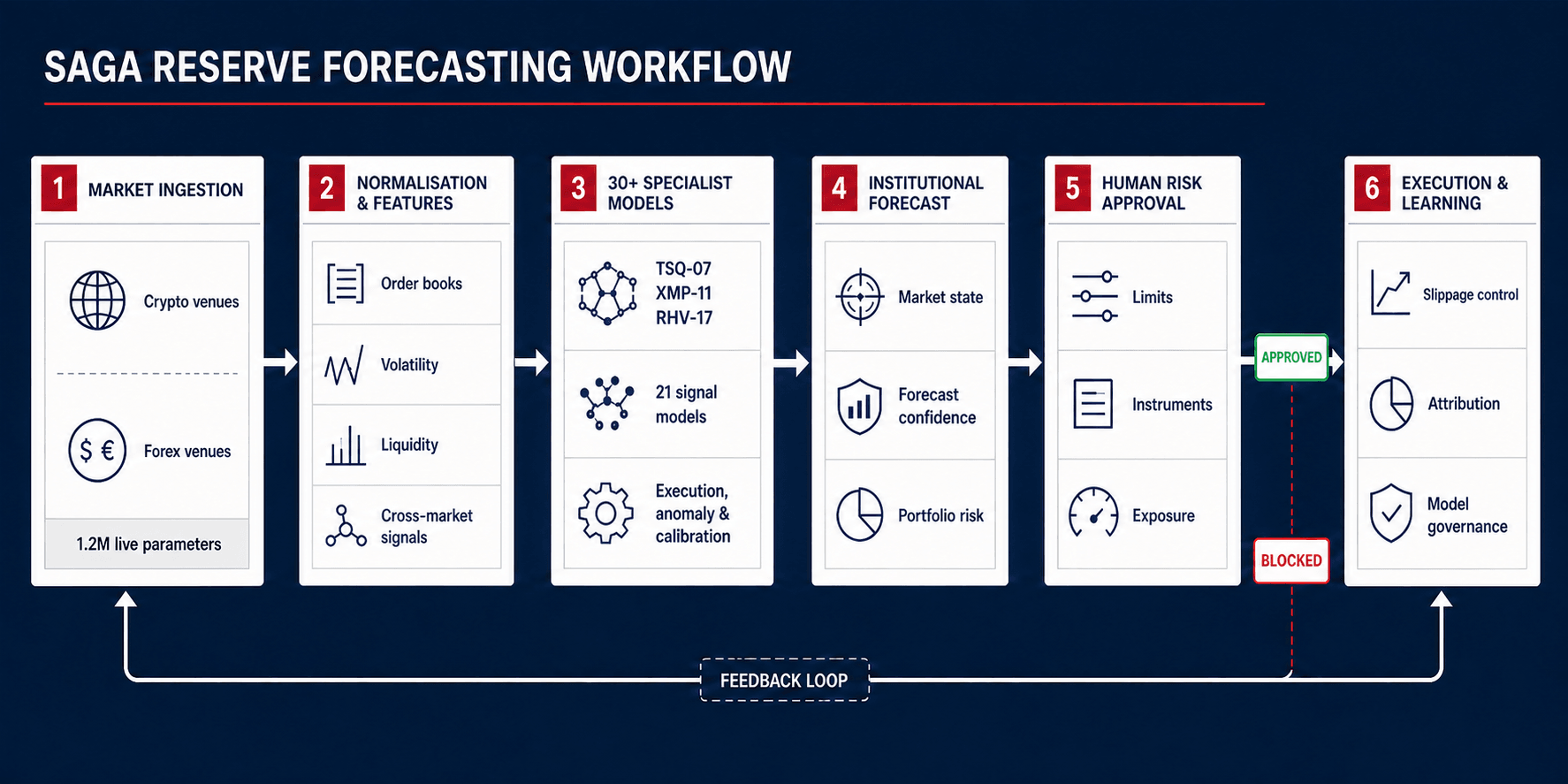
From venue data to a governed fill

The full forecasting path, from 1.2 million live market parameters and 30+ specialist models to human risk approval, controlled execution and continuous learning.

Saga Reserve forecasting workflow from 1.2 million live crypto and forex market parameters through TSQ-07, XMP-11, RHV-17 and 30-plus specialist models to institutional forecasts, human risk approval, controlled execution and learning

Quantitative basis

Relations behind the controls

These standard relations make the system’s state, sizing and drift logic inspectable to a quantitative reviewer.

Posterior over market state

State estimation

p(θ | Dt)   ∝   p(Dt | θ)   p(θ | Dt−1)

The previous posterior becomes the next prior. New evidence updates the platform’s view of market state without allowing a single unusual session to erase everything learned before it.

θ — market state · D — observed evidence to time t

Uncertainty-scaled position sizing

Risk

f* = ( μ − r ) / σ2    →    fused = λf*,   λ < 1

Sizing scales with estimated edge and inversely with variance. A wider posterior therefore reduces exposure automatically, while a fractional multiplier avoids assuming that the estimate of expected return is exact.

μ — expected return · r — risk-free rate · σ² — variance · λ — fractional multiplier

Order-book imbalance

Features

It = ( Vbid − Vask ) / ( Vbid + Vask )

The bounded feature is comparable across instruments whose absolute depth differs materially, making it useful in the short-horizon feature set across crypto and foreign-exchange venues.

V — resting volume within a fixed depth of the touch

Distributional drift

Model governance

DKL( Plive ‖ Ptrain ) = Σ Plive(x)   log ( Plive(x) / Ptrain(x) )

The platform monitors separation between the feature distribution observed in production and the distribution used for fitting. That evidence can demote a model before drawdown becomes the only warning.

P_live — current feature distribution · P_train — distribution at fit time

Delivery sequence

How the programme progressed

Years 1–2

Research and market modelling

Venue coverage, feed normalisation and first-generation market-state models were tested against recorded books and discarded when evidence did not hold.

Years 2–4

Hybrid-intelligence core

Three advanced Root Digit Labs models, 21 specialist signal models, additional forecasting components and the human-approved risk mandate were engineered as one governed system.

Years 4–5

Execution and risk

Independent pre-trade controls, slippage-aware execution, post-trade attribution and external security review.

Years 5–6

Scale and operating hardening

Additional venues and instruments, model governance for the expanding ensemble and institutional operating tooling.

Outcomes and evidence

What the solution achieved

These figures describe the model composition, concurrent forecasting capacity and six-year engineering programme delivered by Root Digit.

120B+
AI parameters

Across the platform’s decision models.

30+
specialist forecasting models

Three advanced Root Digit Labs models, 21 specialist signal models and additional execution, anomaly and calibration predictors.

1.2M
live market parameters ingested concurrently

Forecasting inputs processed within the same calculation cycle.

6 years
development programme

Research, implementation, execution and hardening.

Engagement conclusion

Saga Reserve extends institutional forecasting beyond human analytical speed and scale without transferring risk authority to the machine: more than 30 models forecast different variables, while people approve the risk-management rules and decisions the system must follow.

Start a conversation

Bring us the operating problem, the constraints and the evidence that matters.

Cookie Policy

We use cookies to enhance your browsing experience, serve personalized content, and analyze our traffic. By clicking "Accept All", you consent to our use of cookies. You can also choose "Necessary Only" to limit cookies to essential website functions only. Learn more