01
Industrial floors defeat single-sensor autonomy
Long blank aisles, dust, glare, steam and moving equipment make any one perception modality unreliable. The platform needed complementary sensors whose failure conditions do not overlap.
Product design case study
Amie
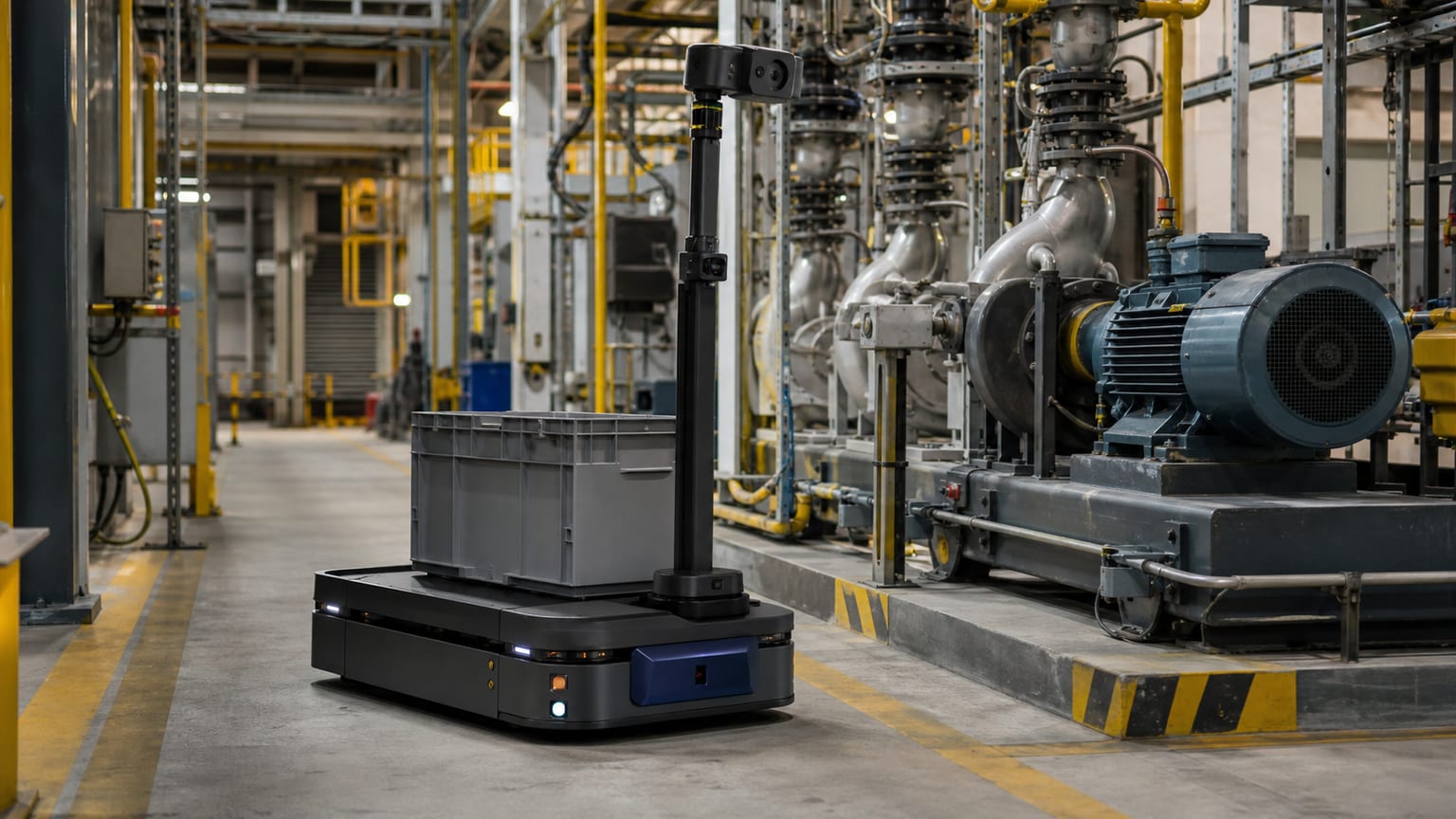
Amie is a Root Digit Labs programme combining autonomous material movement with continuous condition monitoring. The design treats transport, inspection, safety and fleet learning as one industrial system rather than separate products.
The problem
Factories usually treat material movement and equipment inspection as separate operating systems. One moves loads on demand; the other checks assets periodically, often after early warning signals have already disappeared.
An autonomous mobile robot already travels the aisles, passes the same machines and carries localisation and compute. The product-design problem was to make that movement useful twice—complete the logistics task while collecting condition evidence that maintenance teams can compare over time.
Why it was difficult
These operating and governance conditions determined what a credible solution had to achieve.
01
Long blank aisles, dust, glare, steam and moving equipment make any one perception modality unreliable. The platform needed complementary sensors whose failure conditions do not overlap.
02
Monitoring had to happen along the working route without turning every mission into a slow survey. Sensor placement, inference and route planning therefore had to share one operating model.
03
A sophisticated planner is too large to serve as its own safety case. Motion commands needed a smaller independent monitor and deterministic control path capable of vetoing unsafe behaviour.
04
Continuous raw footage can expose processes, people and layouts. The control path and primary inference therefore had to remain at the edge, with fleet learning designed around aggregated updates rather than exported recordings.
The solution
Root Digit is designing Amie as an edge-first autonomous mobile platform that performs material handling and condition monitoring on the same route.
The current architecture combines tightly coupled LiDAR-inertial localisation, stereo vision, thermal sensing and structure-borne acoustics with a hardened ROS 2 runtime, a real-time motion layer and an independent safety monitor. A digital twin supports policy training before changes reach physical hardware.
How we did it
The workstreams below show how the solution was designed, built and controlled.
01
Route, payload, docking and inspection requirements were modelled together so condition monitoring uses the path the platform already needs to travel instead of creating a second mission system.
02
LiDAR and inertial sensing maintain geometry and motion state, while stereo, thermal and acoustic channels contribute semantic and equipment-condition evidence. The modalities are chosen for different failure modes, not for sensor count.
03
Navigation, docking and inspection policies are trained across randomised friction, lighting, payload and sensor conditions. Physical release follows validation against the digital twin rather than a single scripted demonstration.
04
A real-time control path is separated from the autonomy stack. An independent runtime monitor checks commanded speed, clearance and deceleration against a defined safety envelope and can veto the planner.
05
Primary perception and control remain on the platform. The fleet-learning design shares aggregated model updates so a defect learned at one unit can improve others without exporting raw plant footage.
System design
01
LiDAR, inertial, stereo, thermal and acoustic evidence is time-aligned into localisation, occupancy and condition models at the edge.
02
The autonomy stack proposes behaviour, while the deterministic control layer and independent monitor retain authority to slow or stop the platform.
03
Comparable route observations build asset history locally; aggregated updates can improve fleet models without making cloud access part of the control loop.
Delivery sequence
Phase 01 · under way
Sensor fusion, learned occupancy representation and mapping are being evaluated against recorded industrial environments.
Phase 02 · under way
Navigation, docking and inspection policies are being trained under domain randomisation and evaluated in the digital twin.
Phase 03 · next
The deterministic control path, safety monitor and physical sensor payload move onto a reference chassis.
Phase 04 · planned
A single unit will run a real route under supervision and be measured against the published design targets.
Outcomes and evidence
These are programme design targets and architecture commitments, not measured production or customer-deployment results.
Supported by autonomous docking and charge scheduling.
Target accuracy for repeatable routes and asset observations.
LiDAR, stereo vision, thermal sensing and acoustics.
Motion and primary inference are designed to operate on site.
Product design conclusion
Amie turns an unavoidable factory journey into two operating outcomes: material reaches its destination, while the plant builds a comparable condition record under an autonomy architecture designed for industrial safety and data control.
Start a conversation
We use necessary browser storage and security technology to operate this website. You may also allow optional functional and aggregate measurement technology. We do not currently use advertising cookies. Learn more